
Why should I care about structural risk categories during early design planning? Read on to find out what they are and why we need to pay attention to them

Introduction
Many of us have probably heard of Risk Categories, though we might not all fully understand their purpose or how to apply them across different project types. If you’ve ever wondered how Risk Categories influence the buildings you work on, this guide will take you through what they mean, why they exist, and how they affect your work. What may seem like an obscure table reference actually defines how a building is expected to perform under extreme conditions, wind, earthquake, flood, snow, or ice – and how resilient it must be to protect occupants and maintain essential functions.
1. What Is a Risk Category?
In the simplest terms, the Risk Category (RC) classifies a building according to the consequence of failure – that is, what happens to human life or public welfare if the structure can’t perform during a major event. The higher the consequence, the higher the reliability and design load requirements.
According to ASCE 7, risk categorization means that “buildings and other structures shall be classified based on the risk to human life, health, and welfare associated with their damage or failure by nature of their occupancy or use.” In practice, this simply means that the purpose of the building, how it’s used and who depends on it, determines the level of reliability expected. The standard requires every structure to be assigned to the highest applicable Risk Category from its governing uses, which is why hospitals, emergency centers, and other essential facilities are always elevated. Rather than viewing this as technical jargon, think of it as the framework the code uses to connect a building’s purpose to its structural resilience – the bridge between occupancy and performance for flood, wind, snow, earthquake, and ice provisions.
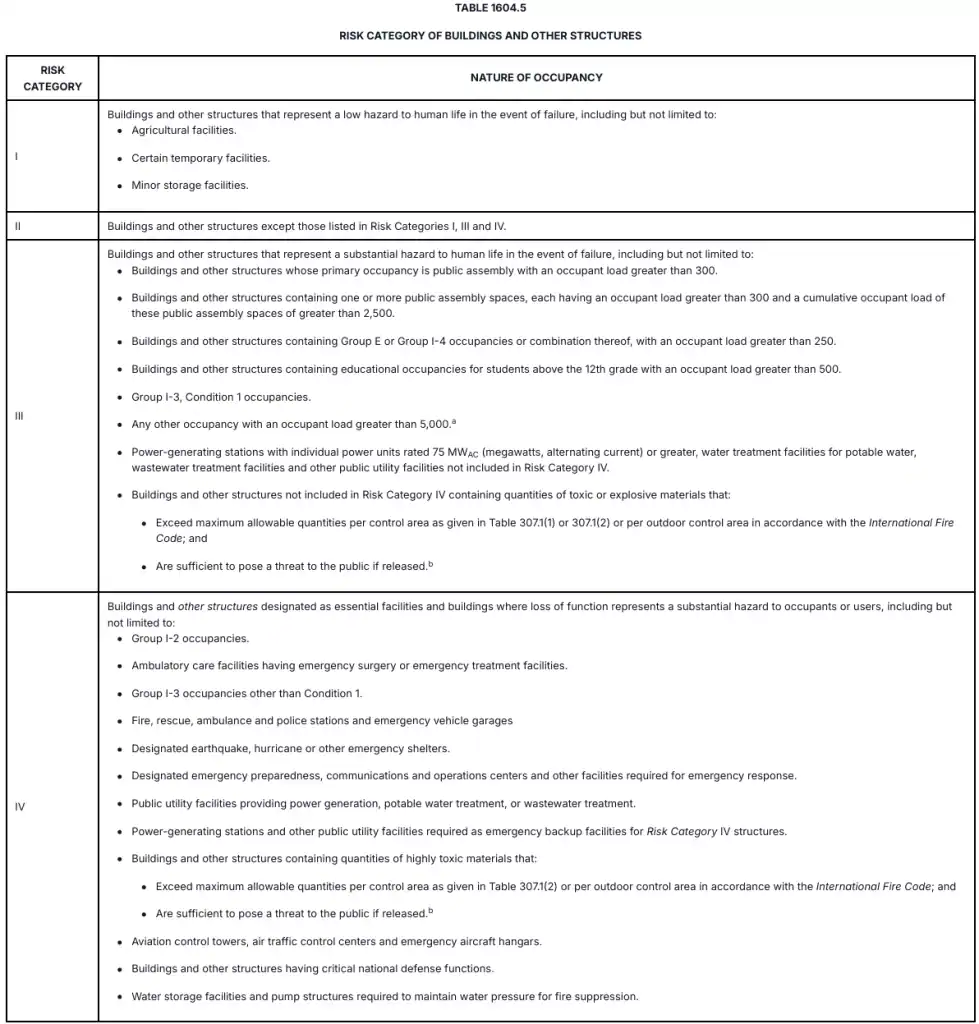
This concept lives in Section 1604.5 of the International Building Code (IBC) and Table 1.5-1 of ASCE 7 (the structural loading standard the IBC references). Each table lists four categories, from RC I (low-risk structures like agricultural buildings) to RC IV (essential facilities such as hospitals, emergency centers, and power plants).
The code’s intent is straightforward: structures that must remain operational during or after a design event should be built to higher reliability standards than those whose temporary loss wouldn’t endanger lives or disrupt communities.
It’s also worth noting that when a referenced standard like ASCE 7 specifies an occupancy or risk category, the IBC takes precedence. Section 1604.5 clarifies that the IBC’s own table (1604.5) must be used in lieu of ASCE 7 Table 1.5-1 whenever there’s a discrepancy. In other words, if you’re following the IBC, its provisions govern the assignment of Risk Category, not the table in ASCE 7. This distinction helps maintain consistency between how buildings are classified and how their structural loads are applied across different codes.
2. When and Why the Concept Emerged
Risk categorization isn’t new. Early structural codes used occupancy categories to describe similar intent, assigning higher importance to schools, hospitals, and emergency centers. ASCE formalized the framework decades ago, but the modern “Risk Category I–IV” language became universal through ASCE 7-10 and the 2006 IBC. By embedding it directly into Chapter 16, the code established a consistent method for linking use with structural performance expectations.
Why the shift? Because acceptable risk is, as ASCE 7 reminds us, “a matter of public policy.” Society tolerates different levels of risk for different building types. Losing a warehouse roof in a windstorm is inconvenient; losing a hospital ICU is catastrophic. The code’s job is to translate those societal expectations into design targets.
3. Why It Matters to Architects
For architects, the Risk Category is more than a structural designation, it’s a program-level decision that can directly affect a project’s feasibility and resilience. Because higher categories often bring structural premiums, typically from the need for greater strength and stiffness in members and connections, driven by RC-specific hazard maps (wind, snow/ice/rain, tornado) and the seismic importance factor (Iₑ), these increases can impact budget, schedule, and performance. It’s important to justify the chosen category early. The goal is balance: delivering public safety and reliability without imposing unnecessary cost or complexity.
In essence, RC defines how robustly a building must perform under extreme conditions and how confidently we can stand behind occupant safety. Understanding this relationship helps architects make informed decisions during programming and design, rather than treating it as a downstream structural issue.
Structural Impact
The RC directly determines the structural design approach, the load combinations, drift limits, and overall stiffness required to meet performance targets. Higher categories demand stronger connections, tighter deflection control, and more robust detailing to ensure safety and continuity under extreme conditions. In practical terms, this means the structural engineer adjusts system sizing and reinforcement while the architect must understand how those decisions affect space, layout, and cost.
Coordination Impact
The RC affects coordination decisions just as much as it shapes structure. Early in design, the architect must recognize which systems, egress routes, life safety, emergency power, lighting, or mechanical distribution, link different portions of a project. When these systems are shared between occupancies, the higher Risk Category applies. This understanding allows architects to plan separations, anticipate infrastructure implications, and align code strategy before engineering models are finalized. In essence, coordination under RC is about designing with clarity, so that structure, systems, and safety align from the start.
Cost and Schedule Impact
Higher categories typically translate to heavier or stiffer systems, more demanding drift limits, and tighter tolerances. On strength-governed buildings, the difference may only be around 1 percent of total cost. On drift-governed mid-rises (such as steel moment-frame hospitals around eight to ten stories), studies have shown 6–16 percent increases. Even small premiums can ripple through budget discussions, so this should be understood at programming, not after structural design starts.
4. The Four Risk Categories in Practice
RC I – Low Risk to Life
Structures with minimal human occupancy or low societal impact if damaged—barns, storage sheds, small agricultural facilities. Often outside the scope of most architectural practice.
RC II – Standard Occupancy
The default category for most commercial, residential, office, and parking garage buildings serving non-emergency vehicles. The structural design balances cost with adequate protection for typical life-safety expectations.
RC III – Substantial Hazard to Life or Crowding
Includes buildings with large occupant loads or assemblies where failure could injure many people: theaters, stadiums, schools, large retail. Also includes buildings used by people with limited mobility such as elementary schools, prisons, and small healthcare facilities. It also covers facilities with hazardous contents.
RC IV – Essential Facilities
Buildings that must remain operational during or immediately after what the IBC and ASCE define as an extreme event—a natural or environmental hazard such as wind, earthquake, flood, snow, ice, or tornado. These events represent the maximum considered design conditions under which a structure is expected to perform without collapse, ensuring occupant safety and continued essential function. The IBC explicitly lists:
- Hospitals and other Group I-2 occupancies
- Most Group I-3 occupancies
- Emergency operations centers
- Fire, rescue, and police stations
- Power-generation, potable water, and wastewater-treatment facilities
The 2024 IBC expands RC IV further, now all I-2 uses are included, not just those providing emergency surgery or treatment. This single change shifts many healthcare projects from RC III to RC IV, carrying new implications for structural design, enclosure performance, and nonstructural anchorage. It also extends to ancillary structures that essential facilities rely on to remain functional. For example, if a hospital designates a heliport located on a parking garage as essential to its emergency operations, and there is no other alternate landing area available, that garage, normally classified as RC II, would need to meet the higher standards of Risk Category IV to ensure continued emergency service capability.
5. How Assignment Works
Section 1604.5 of the IBC spells it out:
“Each building and structure shall be assigned a risk category in accordance with Table 1604.5.”
For multi-occupancy buildings, the highest category controls unless the portions are structurally separated. The same applies to shared systems: if two parts of a complex share egress paths, fire-protection systems, emergency power, lighting, or mechanical or plumbing systems required for the function of an RC IV portion, then both are treated as RC IV.
This clause is why, for example, an administrative wing physically connected to a hospital may inherit the hospital’s RC IV unless there’s a complete seismic and life-safety separation.
6. What Risk Category Controls
Once assigned, RC drives:
- Design loads (wind, seismic, snow, ice, rain, flood, tornado)
- Drift limits and serviceability criteria
- Envelope pressures and cladding attachment
- Anchorage of nonstructural components
- Designated seismic systems (those required to function after an earthquake)
- Post-event operability expectations
Each of these design demands ties directly into the concept of importance factors, which quantify how load effects increase for higher-risk buildings. Understanding what RC controls helps frame why importance factors exist, and how they apply differently across hazards in ASCE 7.
For architects, this affects everything from façade design to MEP equipment anchorage. It also informs conversations about redundancy, backup power, and continuity planning. In an RC IV hospital, even mechanical penthouses, canopy structures, and attached garages might need to maintain functionality or life-safety performance during an event.
7. Importance Factors – What They Are (and Aren’t) Now
An importance factor – defined in ASCE 7 as part of the Design Loads for Buildings and Other Structures, is a multiplier applied to base design loads to reflect a building’s occupancy and consequence of failure. It increases or decreases the magnitude of flood, wind, snow, seismic, and ice loads based on the assigned Risk Category. Typically, base design loads are calculated for a 2% annual probability of exceedance (for example, 2% in 50 years for seismic loads). A higher importance factor proportionally raises these loads, for instance, a wind importance factor of 1.15 increases design wind pressures by 15%.
In older code editions, importance factors were explicitly listed for most hazards. However, in ASCE 7-22, many of these have been absorbed into risk-targeted hazard maps – meaning that wind, snow, and ice reliability adjustments are now built directly into the mapped load data rather than applied as separate multipliers. The only major importance factor still in use is the seismic importance factor (Iₑ), which remains necessary due to the unique collapse-prevention philosophy in seismic design.
- Seismic Iₑ = 1.5 for RC IV (unchanged).
- Snow/Ice factors have been removed; the maps themselves incorporate the reliability differential.
- Wind has no Iw since 2010; each RC uses its own wind-speed map.
For coordination clarity: if your team is looking for an “importance factor for snow,” it no longer exists in 7-22. The risk sensitivity is baked into the map values themselves.
8. What Changed in ASCE 7-22 and the 2024 IBC
Snow, Ice, and Rain
ASCE 7-22 rewrote the way environmental hazards are assigned. Historically, engineers applied importance factors (Iₛ for snow, Iᵢ for ice) to amplify loads for higher RCs. In 7-22, those adjustments are built into the hazard maps themselves. The new “risk-targeted” maps already account for lower probabilities of failure for RC III and IV buildings, so separate importance factors are no longer needed.
Wind
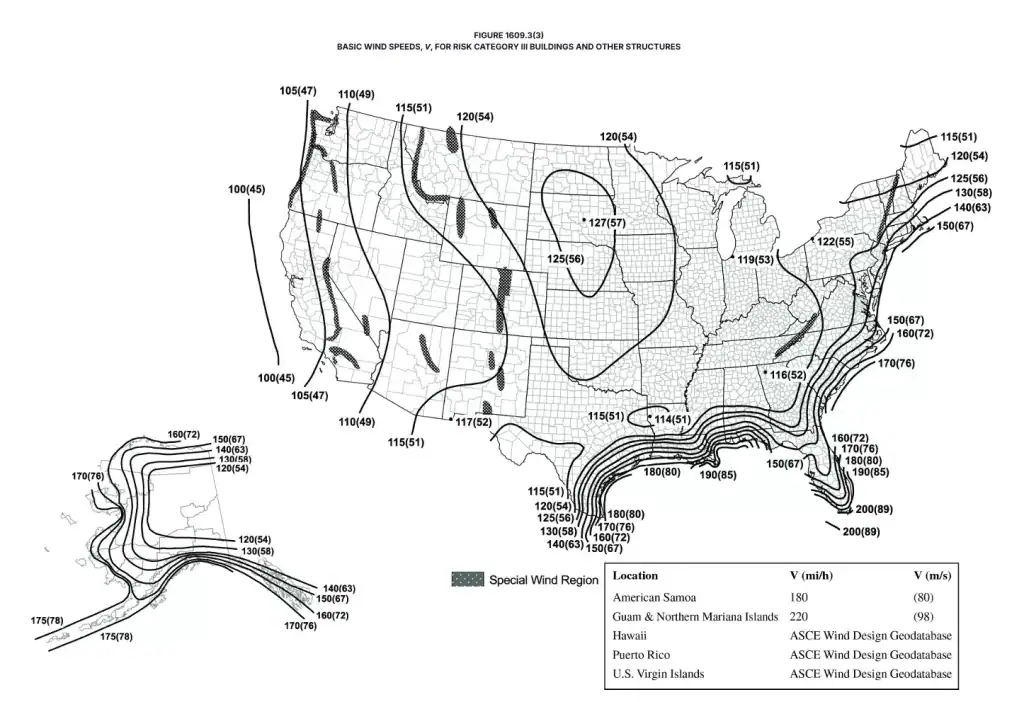
Wind importance factors disappeared earlier, in ASCE 7-10, replaced by risk-category-specific wind-speed maps. Each RC has its own base wind speed; RC IV structures might use 130 mph where RC II uses 115 mph. The philosophy is the same: higher consequence → higher reliability.
Seismic
Seismic design still uses an importance factor (Iₑ) because earthquake design aims to prevent collapse during the risk-targeted maximum considered earthquake (MCER) rather than control load probability directly. The Iₑ factor maintains a separate reliability target consistent with that collapse-prevention philosophy.
Tornado
ASCE 7-22 introduced new probabilistic tornado maps, keyed to RC. RC IV buildings use a lower annual exceedance probability, again, a reliability shift embedded in the maps.
Building-Type Updates in the 2024 IBC
- All Group I-2 occupancies (hospitals, nursing homes, psychiatric facilities) are now RC IV.
- Most Group I-3 (detention/correctional) facilities also move to RC IV.
- Public utility facilities – power generation, potable water, wastewater, are clarified as RC IV.
- Freestanding parking garages are now RC II by default, unless they store emergency vehicles or serve as required egress for a higher-RC building.
These are major reclassifications that architects must track during code analysis and early coordination.
9. Why Risk Category Shouldn’t Be an Afterthought
Architects sometimes treat RC as a structural formality, something engineers handle in their calculations. That’s a mistake. Risk Category shapes the fundamental performance intent of your building. It drives how resilient the facility will be, how it interacts with emergency infrastructure, and how it performs long after occupancy. It also informs owner expectations about continuity of operations, a critical topic in healthcare, data centers, and government projects.
Treat RC as part of your design narrative: it’s where safety, function, and public trust intersect. Bringing this mindset full circle reinforces the architect’s proactive role in establishing RC early and ensures the project’s performance intent aligns with its purpose.
10. Final Thoughts
Risk Category is not just a line in the structural notes, it’s a statement about how society values a building’s function. For hospitals, schools, and emergency facilities, the decision to assign RC IV expresses an intent for resilience and continuity. For standard occupancies, RC II strikes a balance between safety and cost. Understanding that continuum helps architects communicate intelligently with engineers, owners, and reviewers.
In practice, the best time to set the Risk Category is before schematic design ends. Once lateral systems, cores, and major mechanical strategies are chosen, changing RC later can be expensive. Document it early, coordinate it across disciplines, and verify it against Table 1604.5.
The codes may speak in tables and load factors, but the principle is simple:
The greater the consequence of failure, the more robust the design must be.
That’s something every architect can-and should-understand.
Be the ONE

References
- ASCE 7-22, Section 1.5.1 Risk Categorization (Amplify, American Society of Civil Engineers)
- STRUCTURE Magazine (March 2024), “2024 IBC Significant Structural Changes – Risk Categories (Part 5)”
- International Building Code 2024 / Section 1604.5 and Table 1604.5 (ICC Digital Codes)