
Ever wonder what delegated design really means? Read on to learn how it works, where it shows up, and how to use it to your advantage.

Introduction: Delegated Design as a Tool for Clarity and Efficiency
There’s no shortage of information out there about delegated design, articles, guidelines, practice advisories, and even entire specification sections devoted to it. But despite its widespread use, the concept is still often misunderstood. The confusion usually isn’t about whether delegation happens (it does, all the time), but rather what’s actually being delegated, who is responsible for what, and how those responsibilities are communicated and coordinated across the project team.
To understand delegated design in practice, it helps to start with something familiar: internal delegation within the architecture team. A project architect rarely draws every sheet, detail, or code diagram themselves. Instead, we delegate parts of the work to team members with the right experience or bandwidth, but we remain accountable for ensuring it aligns with the overall design intent and integrates with the rest of the set. The same principle applies to delegated design. The key difference is that in this case, the contractor brings specialized engineering knowledge to the table, particularly for proprietary systems or fabrication-based components.
With delegated design, we still provide performance criteria and design intent, but the contractor is responsible for completing the technical design with a licensed engineer who submits sealed documentation.
Used correctly, delegated design is not about shifting liability or punting scope. It’s a strategy to work more efficiently, make use of specialized expertise, and focus the design team’s effort where it brings the most value to the project.
This post looks at what delegated design really is, where it shows up most often, and how we can manage it effectively to keep control of design intent while improving project delivery.
Where Delegated Design Comes From
Delegated design didn’t start as a legal tactic or a contract clause. It grew out of practice, specifically, the need to make buildings more constructible, more efficient, and more coordinated. As systems became more specialized and proprietary, and as project schedules became more compressed, we began turning to contractors and fabricators not just to build components, but to engineer them too.
Some of this shift came from experience. We learned that certain trades, like curtain wall vendors, fire protection subcontractors, or structural steel fabricators, knew more about their systems than we did. They understood tolerances, logistics, load paths, and how the shop drawings would get built in the field. Rather than trying to reverse-engineer a vendor’s product from the outside, it made more sense to tell them what we needed their system to do, and let them design it from the inside.
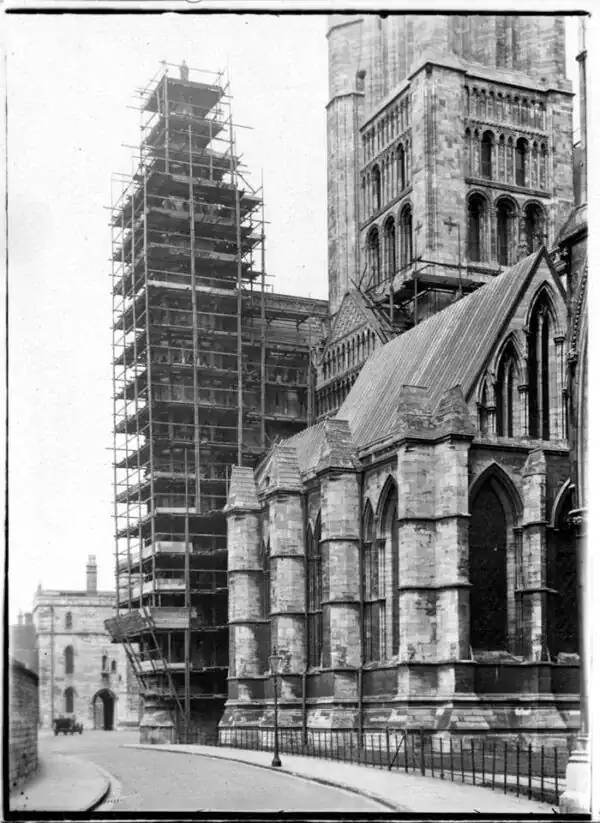
Delegated design isn’t a modern invention, it’s a refined continuation of something architects have always done: lead the vision and rely on others to help realize it. From master builders sketching cathedrals to early modern architects producing lean drawing sets, delegation has always been part of how architecture gets built. What’s changed is the level of documentation and liability. What hasn’t changed is the need to coordinate with care.
At the same time, the way projects were delivered, and how responsibilities were divided in contracts began to shift. Design-build became more common. So did early procurement and preconstruction coordination. It was no longer realistic, or expected, for the architect to produce fully detailed designs for every component. Instead, we began building in space, scope, and language for others to carry that work forward.
Delegated design sits within that evolution. It’s not a shortcut or a loss of control. It’s a formal way to shift responsibility to someone better suited to do the work, while still keeping the architect in charge of performance, coordination, and code compliance.
That shift only works, though, if it’s clear what’s being delegated and why. And that’s where scope descriptions, drawing notes, and specification language play a critical role.
How Delegated Design Is Structured in AIA Contracts
Delegated design isn’t something you just “call out” in a keynote and expect to be picked up in the shop drawings. It’s a defined process, and AIA contracts provide the structure to clarify roles and responsibilities. The core language appears in AIA A201, Section 3.12.10, which outlines how design services provided by the contractor are to be handled when those services are required by the contract documents.
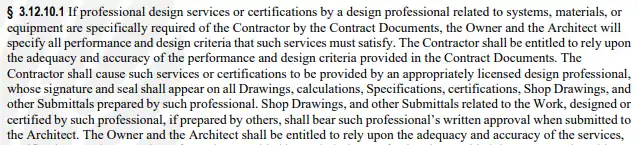
The process starts with the architect and owner identifying the scope of services being delegated. This means clearly stating the performance and design criteria that the contractor’s engineer must meet. These criteria need to be specific, enforceable, and based on code, loading, and functional requirements.
The contractor is then responsible for completing the technical design, using a licensed design professional to prepare and seal all required submittals. These may include drawings, calculations, certifications, or engineering reports, depending on the system.
Importantly, A201 does not remove the architect from the process. The architect still reviews the submittals, but only to confirm that they align with the performance criteria and the overall design intent. This is not a full peer review. It is a focused review to ensure the delegated design fits into the project, satisfies the design requirements, and coordinates with adjacent systems.
A201 also provides for mutual reliance. The contractor can rely on the criteria provided by the architect, and the architect and owner can rely on the sealed engineering submitted by the contractor’s team. That reliance cuts both ways, if flawed or incomplete criteria are provided by the architect or owner and the contractor designs to those, responsibility for the outcome remains with the original source. That’s why it’s critical to define the scope clearly, and correctly, from the outset.
This process only works if both sides fulfill their responsibilities, and that starts with well-drafted documents and clearly set expectations.
Where Delegated Design Shows Up Most Often
Delegated design typically applies to systems that are proprietary, structurally sensitive, or trade-specific. These are areas where the architect defines the performance criteria, scope, layout, and aesthetic goals, and the contractor or vendor takes responsibility for completing the engineering and detailing during construction.
Miscellaneous Metals and Structural Steel Components
- Overhead equipment supports and hanger assemblies
- Equipment platforms and some rooftop dunnage
- Masonry shelf angles
- Cold-formed metal framing for exterior and interior applications
- Steel and concrete stairs, including attachments for handrails and guardrails
- Structural steel connections
- Elevator rails and associated brackets
Ornamental and Specialty Metals
- Custom railings and decorative guards
- Glazing shoes and edge trim
- Door entry systems and associated support framing
- Metal covers, plates, and surrounds
- Panel framing or substructure for cladding systems
Ceiling and Overhead Systems
- Black iron framing and suspension systems
- Hanger rods, bracing, and lateral restraint
- Support for ceiling-mounted devices and soffits
Facade and Envelope Systems
- Curtain wall and storefront assemblies
- Terrace paver systems with pedestal layout
- Wind uplift verification for roofing systems
Mechanical, Electrical, and Plumbing (MEP)
- Mechanical equipment supports, pads, and frames
- Pipe racks, trapezes, and seismic restraints
- Rooftop curbs, rails, and platforms
- Fire protection system layout and hydraulic calculations (check jurisdictional requirements)
Code-Driven or Specification-Based Engineering
- Any component requiring design to meet specific code-based performance such as wind, seismic, or drainage
- Systems built from proprietary products that require engineered installation details
Some scopes are fully delegated, including calculations and sealed drawings. Others may only require limited design input, like anchorage details or wind load verification. In all cases, the architect’s role includes defining layout, performance, and aesthetic intent, while the contractor delivers a code-compliant and constructible system based on those parameters.
Why Delegation Works: Steel Connections as a Case Study
One of the clearest and most routine examples of delegated design is the design of structural steel connections. In nearly every commercial project, it is standard practice for the Structural Engineer of Record (EOR) to delegate the detailed connection design to the contractor’s steel fabricator or engineer.

Why? Because it works better that way.
Specialty engineers and steel fabricators are equipped with the tools, software, and expertise to develop efficient, buildable connections. They understand fabrication tolerances, sequencing, field welding constraints, and erection procedures. Their designs are often more practical and economical than those produced by the EOR.
The EOR doesn’t walk away. They review the delegated design to confirm it aligns with the structural design criteria and satisfies requirements for strength, serviceability, and coordination. This allows them to stay focused on the overall structure while maintaining oversight of critical components.
This model applies beyond steel. Curtain walls, stairs, mechanical supports, and canopies often follow the same logic: the design team defines what the system must achieve, and the contractor’s engineering team delivers the means to achieve it.
The Role of Specifications: Performance vs. Proprietary
Delegated design typically originates in the project specifications. When a performance spec is written, the architect defines the functional outcomes a system must achieve, such as structural loads, wind resistance, deflection limits, fire ratings, or acoustic separation, without drawing every detail.
This doesn’t mean the contractor is working from a blank page. The architect still defines the scope, geometry, and visual design. Curtain walls are a good example: the design team lays out the grid, mullion sizes, materials, finishes, and alignment with surrounding elements. The contractor’s engineer then develops calculations and details to meet those requirements.
Stairs follow a similar pattern. The architect defines the stair layout, width, rise/run, clearances, and railings, and the contractor engineers how the stair is framed, fabricated, and supported.
Specifications may be performance-based or incorporate proprietary systems. Even when specific products are listed, those systems often still require custom engineering to suit the building layout. The spec must clearly indicate what is being delegated, what submittals are required, and what must be sealed by a licensed professional.
It’s also important to distinguish delegated design from means and methods:
- Means and methods cover how the contractor builds a system, sequencing, installation, access, etc.
- Delegated design covers how the system is engineered to meet performance and design requirements.
They may appear side by side, but they are not the same. Delegated design doesn’t shift responsibility for how something is built, it expands the design effort into the contractor’s team to complete the engineering based on clearly defined criteria.
Managing Delegated Design Effectively
Delegated design can bring clarity and efficiency to a project, but only if it’s planned, documented, and coordinated with care. While the contractor’s engineering team carries the design burden, the process starts with the architect. How the delegation is defined, tracked, and reviewed will determine whether the outcome supports the overall design or creates confusion and delay.
Best practices include:
- Define the scope in Division 01
Don’t rely solely on technical spec sections. Division 01 should spell out which components are delegated and what the contractor must submit, sealed drawings, calculations, timelines, and coordination responsibilities. - Require a licensed engineer’s seal
Delegated design requires a professional engineer’s involvement. Confirm that the engineer is licensed in the project jurisdiction and include this requirement in the specifications. - Coordinate delegated systems early
Even if final details come later, basic assumptions, layout, loads, clearances, must be shown in the design drawings to allow for structural and spatial coordination. - Build time into the process
Delegated components are often submitted later in the process. Their review may trigger redesigns or require coordination with other systems. Treat them as critical-path items, not add-ons. - Use delegation to manage effort, not avoid responsibility
Delegation should mirror how design work is handled internally, sharing the workload intelligently while maintaining design leadership.
Final Thoughts
Delegated design should never be a surprise. If the intent is to shift part of the engineering scope to the contractor, those expectations need to be communicated early, especially when a construction manager is involved. These discussions should happen before subcontracts are awarded, to ensure everyone understands what’s required and how it will be managed.
That clarity must carry through to the contract documents. Delegated scopes should be acknowledged in subcontractor agreements, not just referenced in drawings or specs, but explicitly defined in terms of deliverables, engineering responsibilities, and review procedures.
Finally, be clear about what delegated design means. Don’t assume the CM or contractor has the same definition in mind. Ambiguity leads to risk. By defining the scope, rationale, and expectations of delegation clearly from the start, the design team stays in control, and the project benefits from shared expertise, smoother delivery, and fewer surprises.
Further Reading:
- AIA Document: What Contractors Need to Know About Delegated Design in Construction
- AIA Document: Delegated Design, What Does It Really Mean?
Be the ONE

Pingback: Design Assist for Enclosures: What Architects Need to Know - One PROJECT ARCHITECT